

Appearance
A consultancy’s report carries its professional judgement. It brings assessment evidence into a form that a client can understand and use. Automating that work means handling the calculations, interpretation, writing and document production while preserving the consultancy’s method and voice.
ReportSwift builds complete reporting systems around the consultancy’s expertise. The consultancy’s methodology guides analysis, its professional voice shapes the narrative, and its review requirements determine where a consultant makes a decision.
For more than a decade, I have brought my training in psychology and computing to reporting systems for research and consulting. I hold a master’s in psychology and a bachelor’s in information and computing science. My work includes systems built within the Centre for Transformative Work Design at the University of Western Australia and the Future of Work Institute at Curtin University. Across that work, my systems produced more than 30,000 psychometric reports and delivered nearly 14,000 dashboards.
That experience is the foundation for my AI work. The practical question has remained consistent: how do you carry a consultancy’s expertise through the whole process of producing its reports?
Connecting the Reporting Workflow
An AI assistant can help a consultant analyse material or draft a section. But someone still has to organise the inputs, supply the relevant context, move findings between tools, correct recurring problems and assemble the document. If those connections depend on the consultant every time, they remain part of the reporting workload.
A custom system makes those connections part of the software. The work with Franchise Relationships Institute (FRI) and Lixivium Consulting shows what that means in practice. Both organisations use reporting systems I designed and built through ReportSwift, operating with real assessment data.
For FRI, the Franchise Mentor workflow turns multi-rater survey data into three connected reports: the franchisee’s self-rating report, the franchisor’s rating of the franchisee, and a comparison report bringing the perspectives together. Templates present scores and fixed content. AI synthesises the evidence into report-specific summaries, practical tips and coaching considerations. A separate audit stage compares the narrative with the assessment material and routes flagged reports for attention.
For Lixivium Consulting, the custom 360-degree feedback platform connects participant and rater administration, data collection, analysis and PowerPoint report production. Templates handle quantitative scores, charts and fixed content. AI brings ratings and written feedback together to develop Areas of Strength and Areas for Development. The platform prepares the complete report draft, with a deliberate consultant review stage before the participant feedback session.
Professional review has a defined place in these workflows. The surrounding system carries the preparation, analysis and document assembly, so review can address the report and its evidence rather than require the consultant to direct each processing step.
The Anchored Narrative Engine: Context and Method
A report needs a clear purpose before AI begins interpreting its evidence. A finding used for leadership development may warrant a different treatment from one used to assess suitability for a particular role. The audience, methodology and intended use determine what the narrative needs to explain.
The Anchored Narrative Engine is ReportSwift’s reporting architecture. It uses the report’s purpose, role, audience and methodology to guide analysis and narrative generation. Conventional software handles fixed calculations; AI interprets evidence and writes within the configured context.
During implementation, ReportSwift configures the workflow around the consultancy’s reporting context. The system applies that configuration during production, so consultants do not need to reconstruct it in each prompt. When reporting requirements change, the configuration needs review.
Within that approach, the Evidence Chain maintains the connection to supporting material, while Adaptive Voice Calibration develops guidance for the consultancy’s professional expression. Together, they address what the report may conclude and how it should communicate that conclusion.
The Evidence Chain: From Sources to Conclusions
A report can sound reasonable while losing an important distinction. A comment from one respondent may become a general description of the participant. A situational concern may appear as an enduring weakness. A score difference may acquire an explanation that the available material does not support.
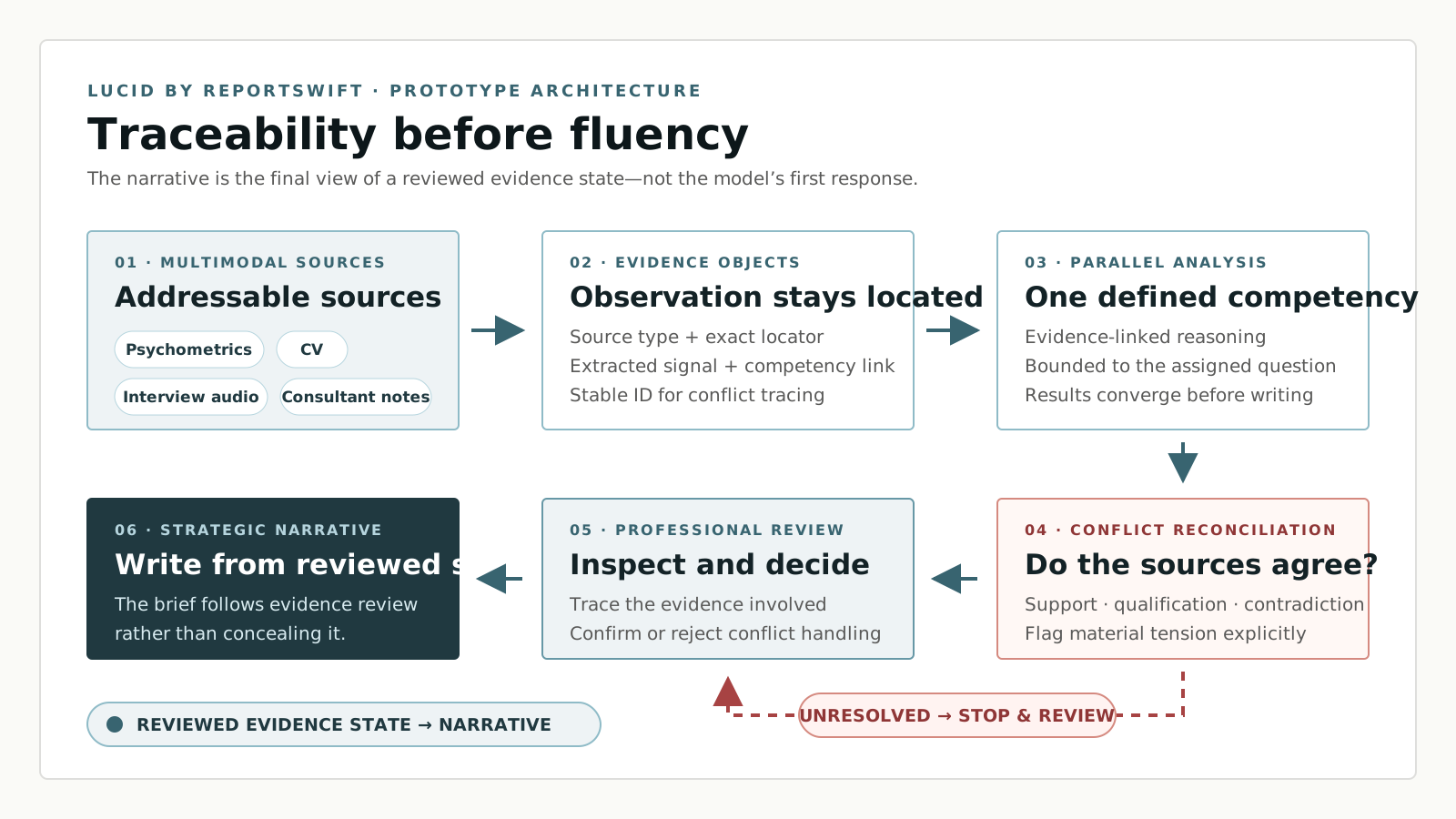
The Evidence Chain connects source-linked facts to insights and narrative. It retains attribution and context so a reviewer can examine a conclusion against the evidence offered for it.
Lucid by ReportSwift demonstrates this part of the approach. It brings psychometric results, a CV, interview audio and consultant notes into competency-level analysis, making the supporting evidence and flagged disagreements visible for professional examination.
Its contribution is to show how an AI interpretation can remain open to challenge. When sources appear to disagree, the psychologist can examine the proposed relationship instead of trying to reconstruct it from a polished summary. A source link does not make the interpretation correct; it gives the reviewer something specific to question.
Lucid was one of the winning projects in Google DeepMind’s Vibe Code with Gemini 3 Pro in AI Studio hackathon, which selected 50 winners from 4,084 submissions. It is a demonstration of the Evidence Chain idea, distinct from the complete client reporting systems.
Adaptive Voice Calibration: Professional Judgement and Expression
Evidence traceability alone does not make a report sound like the consultancy that produced it. Professional voice includes how a firm balances strengths and development needs, expresses uncertainty and turns findings into useful guidance.
Adaptive Voice Calibration turns consultant corrections into reusable guidance for how the system represents evidence, forms insights and writes reports. The guidance captures the professional reasoning behind a correction, so subsequent reports have more than an example to imitate.
If a consultant says a paragraph is too negative, changing its tone may leave the underlying problem intact. The analysis may have given a narrow concern more weight than the broader evidence supports. The correction then belongs in how the insight is formed, as well as in how it is written.
During calibration, ReportSwift traces consultant feedback to the underlying evidence, interpretation or wording decision, updates the guidance and tests it on new cases. Consultants provide professional direction and confirm whether the resulting reports reflect their approach. Calibration preserves assessment scoring and fixed methodological weights.
Once tested and confirmed, that guidance becomes the starting point for subsequent reports within the same reporting method and purpose. The production workflow applies it as it forms insights and writes. Professional input during development therefore shapes recurring production without requiring the consultant to repeat the same direction for each report.
From Assessment Data to Finished Report
The commercial reason to connect these elements is straightforward: work left between tools remains work someone has to do. An AI-generated analysis is useful, but its value to a consultancy also depends on what it takes to bring that analysis through to the report used with the client.
For ReportSwift, that means designing the reporting workflow alongside its evidence handling and professional voice. The Anchored Narrative Engine establishes context and method. The Evidence Chain preserves support for the findings. Adaptive Voice Calibration carries the consultancy’s professional approach through interpretation and expression.
Lucid makes the evidence connection visible. FRI and Lixivium show the wider scope of the work: systems that carry assessment data through to report production, with professional review placed deliberately within the process.
The objective is a reporting system in which the consultancy’s expertise becomes a durable part of how the work gets done.